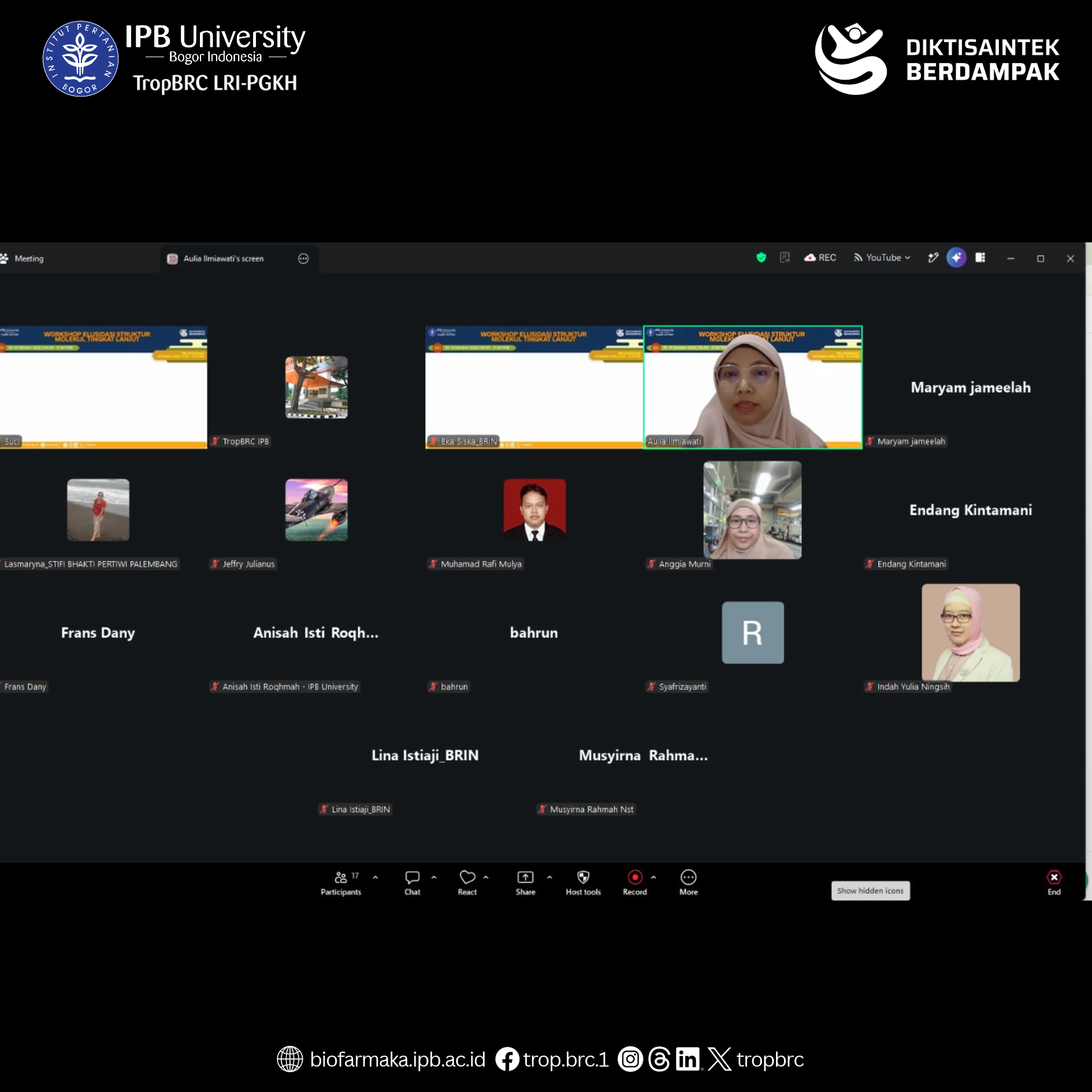
Tropical Biopharmaca Research Center (TropBRC) LRI-PGKH IPB University recently held an advanced molecular structure elucidation workshop. They hosted this two-day virtual training via Zoom from October 30 to 31, 2026. Ultimately, the event attracted 17 participants. These professionals and academics joined from various institutions.
Prior to the main event, organizers arranged a technical session on October 29. As a result, attendees could prepare properly for the training. During this preliminary step, participants installed essential analytical software. Specifically, they set up MestReNova and ChemDraw. This preparation ensured a smooth experience for the upcoming lectures.
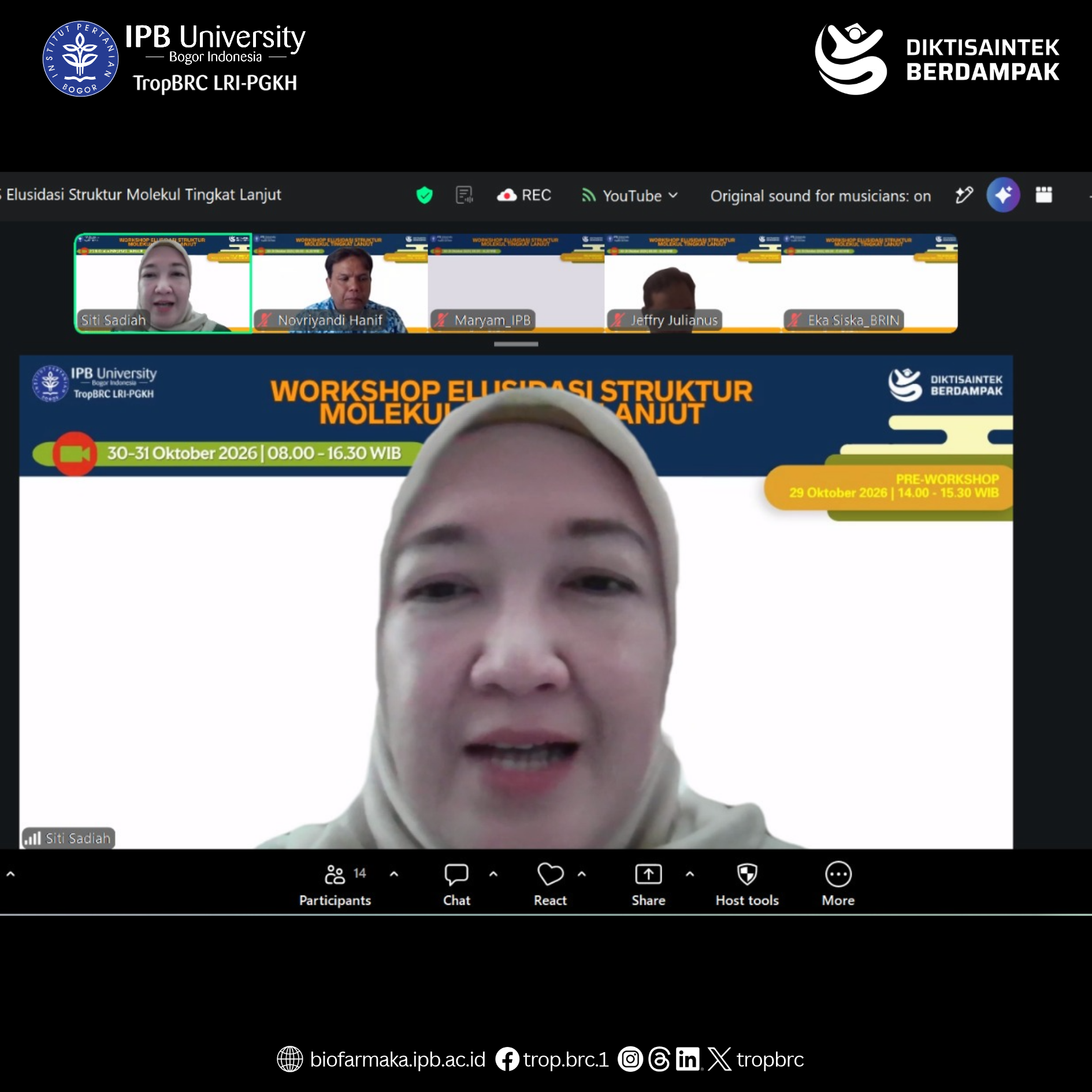
Dr. apt. Siti Sa’diah, M.Si., Secretary of TropBRC LRI-PGKH, officially opened the event. In her opening remarks, she highlighted a key milestone in natural product chemistry. Specifically, she noted that isolating a compound is a major achievement. However, a significant challenge remains afterward. Researchers must accurately determine its molecular structure using analytical data. Furthermore, Titis Arifiana, S.Si., served as the Master of Ceremony. She guided the virtual event seamlessly over both days.
Molecular Structure Elucidation Workshop: Practical Training
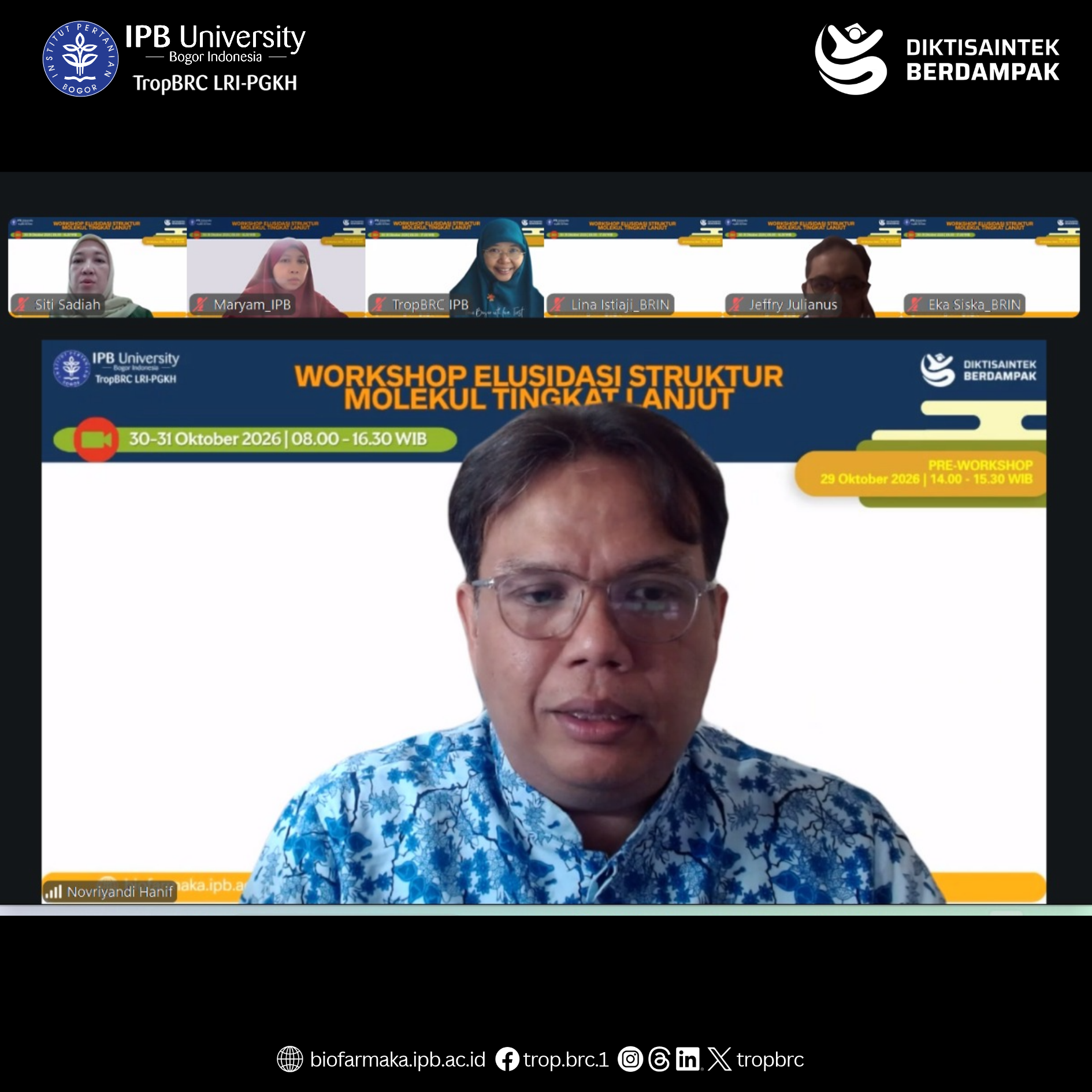
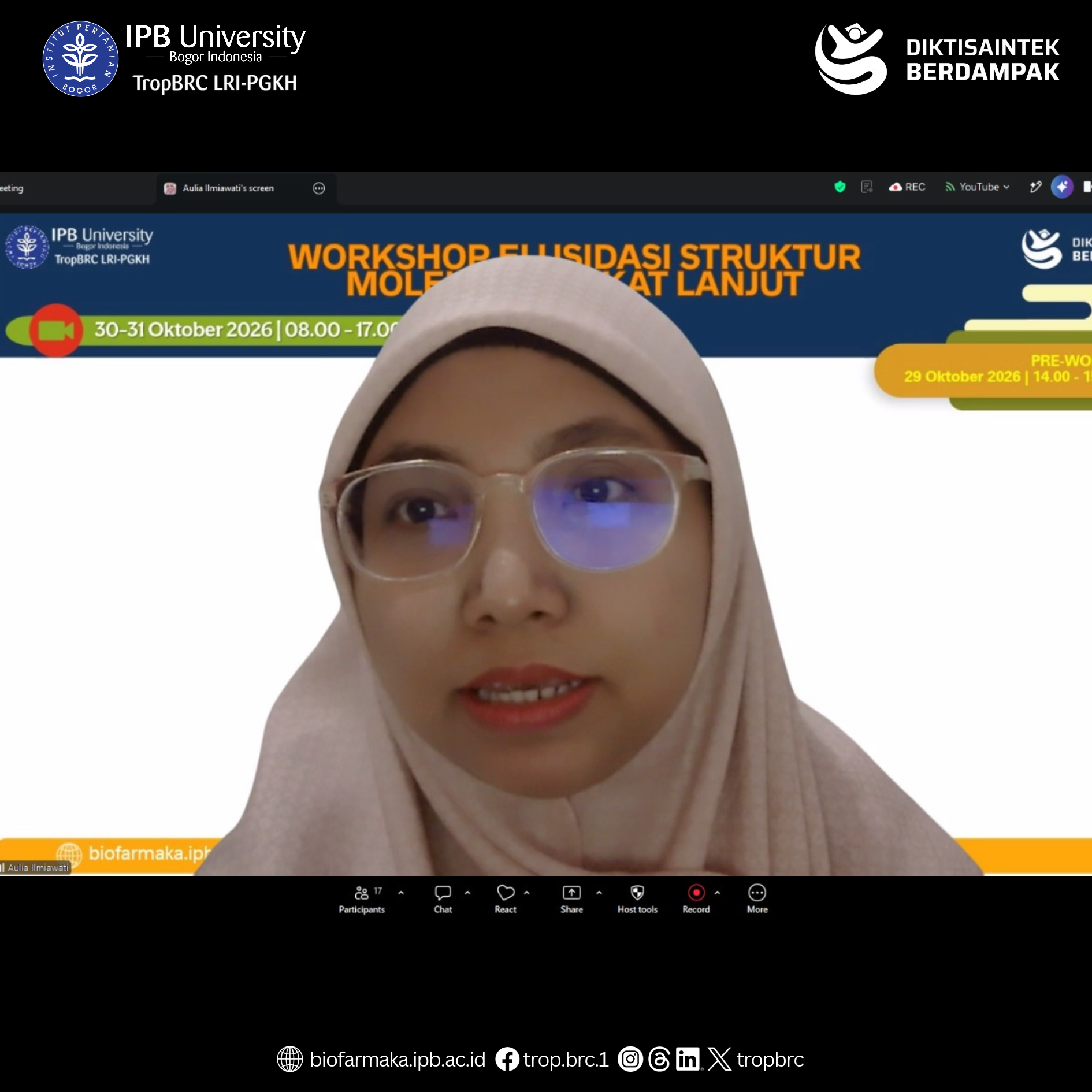
The educational program provided an intensive look at spectroscopic methods. Expert resource persons led these essential core sessions. Novriyandi Hanif, S.Si., M.Sc., D.Sc., and Dr. Auliya Ilmiawati, S.Si., M.Si., shared their deep knowledge. Additionally, laboratory assistants provided dedicated technical support. Yoga Kusumo Titis Maha Dipa, S.Si., and Mohammad Fachri Aulady, S.Si., assisted attendees throughout the event.
On the first day, participants explored introductory analytical strategies. Moreover, they studied Ultraviolet (UV) and Infrared (IR) spectroscopy principles. These important tools help researchers identify chromophores and functional groups. Later, the speakers discussed advanced mass spectrometry (MS) applications. Specifically, they covered molecular ions, fragment ions, and molecular formulas. They also explained mass errors and complex fragmentation mechanisms.
Next, the second day focused on Nuclear Magnetic Resonance (NMR) techniques. The experts detailed the principles for planar and stereochemical structures. Afterward, Dr. Auliya Ilmiawati guided the practical application sessions. The program finally concluded with strategic isolation tips. For example, experts explained how to isolate non-polar and polar pure compounds. They also addressed compounds with varying molecular weights.
Overall, participants expressed strong enthusiasm for the training. Furthermore, they provided excellent feedback on the educational materials and responsive organization. As organizers noted, mastering this field involves more than just reading spectra. Indeed, it requires precision and linking scientific evidence. Consequently, researchers can build defensible interpretations to advance scientific discovery.
✍️ Author & Editor: Tiest
📸 Documentation: TropBRC Workshop Team